Menu

- Monday - Saturday 09:00 AM- 8:30 PM
- Sunday - CLOSED

- +91 9319211545
- info@drrajeshmalhotra.com

- A -71, Second Floor, Rajouri Garden
- Metro Station, Delhi - 110027, INDIA
 93192 11545
93192 11545
93192 11545


Reviewed by Dr. Rajesh Malhotra | MS (Ortho) | Professor & Head of Orthopaedics, AIIMS | Orthopedic Surgeon, Rajouri Garden, Delhi
If a hip is threatened by avascular necrosis and the femoral head has not yet collapsed, core decompression is the most established operation we have for saving it. It has been done for decades. We understand how it works, and in patients selected properly the outcomes are worth having, because it delays or prevents a total hip replacement in a condition that otherwise progresses fairly predictably. The thing to understand about it is that the same feature which makes it effective also makes it urgent. It works in early AVN, and it works much less well once that window has closed.
AVN begins when the blood supply to the femoral head is disrupted. Bone tissue without blood dies. Dead bone weakens, and weakened bone cannot carry body weight indefinitely, so the rounded head of the femur eventually collapses and the joint surface is lost with it.
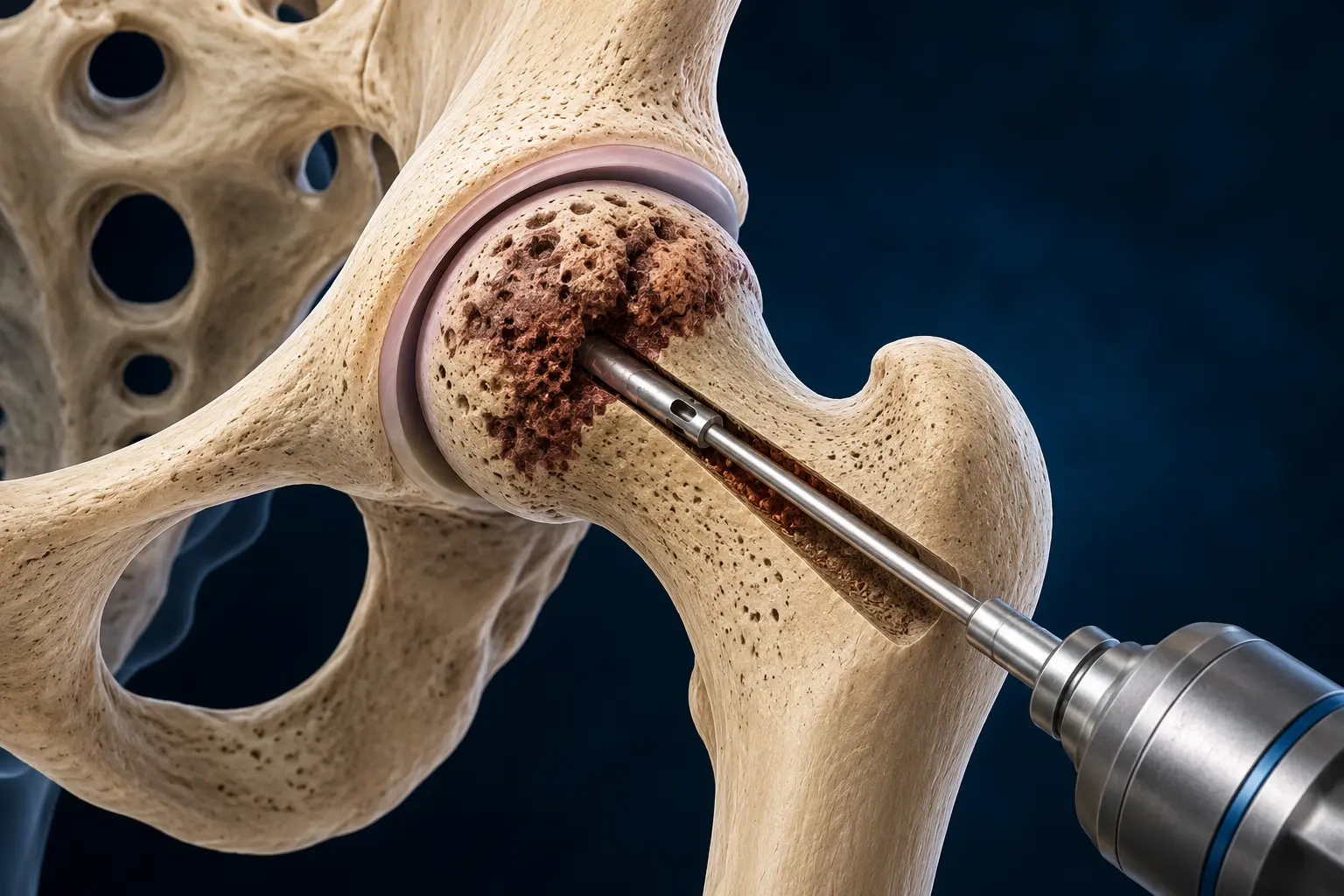
Core decompression works on two fronts. A PMC review of the procedure sets out the primary mechanism, which is that drilling one or more channels through the femoral neck into the necrotic area brings down the raised intraosseous pressure feeding further ischemia, and so interrupts the cycle. The second effect follows from the first. Those drill channels give new blood vessels a route into the compromised area, which is the revascularisation we are hoping for.
The operation is usually done under general or regional anaesthesia, with the patient positioned on a traction table so the hip can be imaged while we work. Under fluoroscopic guidance a drill or trephine goes in through the lateral cortex of the femur and is directed into the necrotic zone inside the femoral head. Set against a hip replacement it is minimally invasive, and it does not open the hip joint at all. Most patients go home within a day or two.
A 2025 PMC case series looking at core decompression in early-stage AVN reported significant improvement in Harris Hip Scores across a follow-up of 28 to 43 months, and both plain core decompression and rotational osteotomy held up over that period in young, active patients.
Almost nothing in this operation matters as much as who you do it on.
It is at its most effective in Steinberg Stage I and Stage IIA, which is to say before collapse, while the architecture of the femoral head is still intact. A PMC long-term study followed 126 patients with 185 AVN hips over an average of 10.7 years and reported clinical survival of 79% for Stage I and 72% for Stage IIA, with the numbers falling away sharply once the disease was more advanced. Lesion size counts too, and small lesions do better than large ones.
By Stage IIC and beyond, where collapse has happened or is about to, core decompression on its own is less effective and we do not generally recommend it as a standalone procedure. Relieving pressure cannot correct structural damage that has already gone that far.
It can, and a good deal of recent work has gone into augmenting it with biological adjuvants. Bone marrow concentrate is the most studied of them, meaning the patient's own stem-cell-rich marrow, aspirated and then injected into the decompressed site. A PMC retrospective study of that technique reported that across 32 hips treated with modified core decompression plus bone marrow concentrate, none progressed to a later AVN stage, and pain reduction was significant in every case.
Where the femoral head also needs structural support, there are other options to consider in selected patients. Tantalum rods. Structural bone grafts. Vascularised fibular grafts.
Recovery means protected weight-bearing for six to twelve weeks, and how long depends on the size of the lesion and on the surgeon's own protocol. Physiotherapy follows, to bring back hip strength and range of motion. Surveillance MRI at intervals tells us whether the necrotic area is healing, holding steady, or moving in the wrong direction.
What we are trying to do here is not undo the damage already done. It is to stop it going further. If you are looking for the best doctor for hip AVN and total hip replacement in Delhi and a surgical consultation is on the cards, see someone experienced in both the joint-preserving procedures and the replacement ones, because that is how you end up with the option that actually suits the stage your disease is at. Contact us at drrajeshmalhotra.com or on +91 93192 11545.
This article is for general information only. It is not a substitute for professional medical advice, diagnosis, or treatment. Always consult your surgeon about your specific hip condition.
Copyright @2026 Design By DigitalNetIndia