Menu

- Monday - Saturday 09:00 AM- 8:30 PM
- Sunday - CLOSED

- +91 9319211545
- info@drrajeshmalhotra.com

- A -71, Second Floor, Rajouri Garden
- Metro Station, Delhi - 110027, INDIA
 93192 11545
93192 11545
93192 11545


Reviewed by Dr. Rajesh Malhotra | MS (Ortho) | Professor & Head of Orthopaedics, AIIMS | Orthopedic Surgeon, Rajouri Garden, Delhi
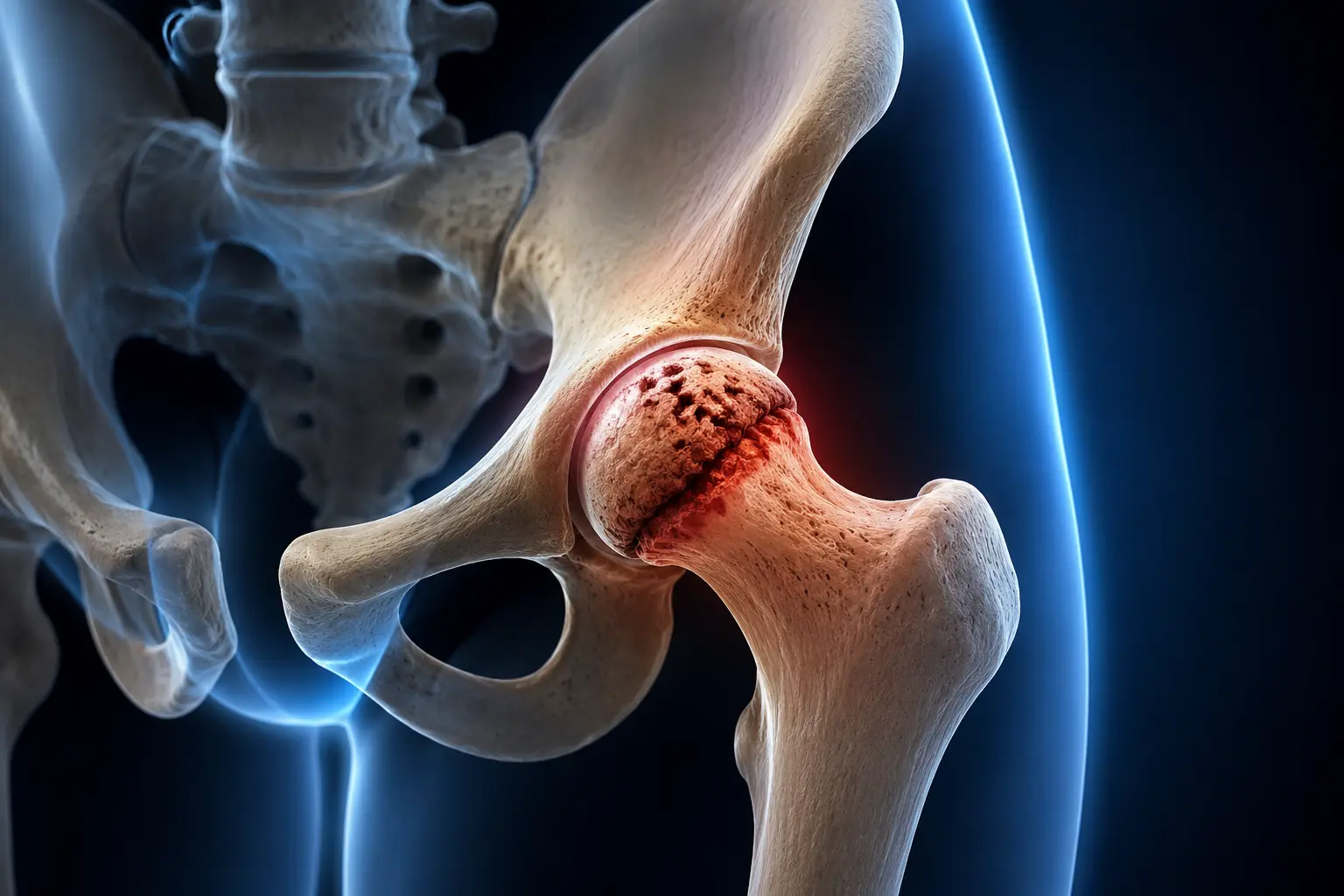
Avascular necrosis (AVN) of the femoral head — the ball at the top of the thigh bone — is one of orthopaedics' more urgent diagnoses, because what happens early in the disease largely determines whether the hip joint can be preserved. Once the femoral head collapses, the joint surface is lost and the path typically leads to hip replacement. Caught early enough, before collapse occurs, joint-preserving options are available that can stop or slow the progression. The difference between these two trajectories is often a question of when the diagnosis is made.
Avascular necrosis means death of bone tissue due to interrupted blood supply. In the femoral head, loss of blood supply leads to bone cell death, weakening of the bone's internal architecture, and eventually collapse of the rounded head under the body's weight. A PMC review of hip-preserving strategies for AVN describes the common causes — trauma to the hip, corticosteroid use, alcohol use, systemic conditions such as lupus, and in some cases no identifiable cause at all. Progression is not always rapid, but without intervention, many cases advance to collapse.
This is where timing is everything. In the early stages — before any collapse has occurred — plain X-rays can be normal. A PMC review of arthroscopic-assisted core decompression notes that early AVN can be detected with 93% sensitivity and 91% specificity using MRI, making it the investigation of choice when the condition is suspected clinically but X-rays are unrevealing. The Steinberg (modified Ficat) classification system grades AVN from Stage 0 (no imaging findings, diagnosis on biopsy or MRI signal change) through Stages I and II (pre-collapse, with progressive MRI and X-ray changes) to Stage III and beyond (subchondral fracture and femoral head collapse). Stages I and II are the window for joint-preserving intervention.
For very early cases, particularly Stage I, a comprehensive PMC review outlines a range of non-operative strategies that have been studied: protected weight-bearing to reduce load on the compromised femoral head, bisphosphonates to inhibit bone resorption, and extracorporeal shockwave therapy — all with varying degrees of supporting evidence. These approaches are most applicable when the necrotic area is small and there is no risk of imminent collapse. Non-surgical treatment alone rarely reverses established AVN but can be part of early management, particularly while surgical options are being considered.
For most Stage I and II cases, particularly where the necrotic lesion is of moderate to large size, surgery is usually recommended to decompress the femoral head before collapse occurs. Core decompression is the most commonly performed joint-preserving procedure for early AVN. One or more tunnels are drilled through the neck of the femur into the area of necrosis, reducing intraosseous pressure and stimulating revascularisation. A PMC long-term study following 126 patients over ten years found clinical survival rates of 79% and 72% for Stage I and IIA respectively — meaning the majority of early-stage patients avoided hip replacement over a decade of follow-up. Core decompression with bone marrow concentrate enhances the procedure by adding the patient's own concentrated stem cells to the decompressed site. A PMC case series using this modified technique found that in Stage I and II hips, none of the patients progressed to further stages, with significant pain relief reported and no observed complications.
Once the femoral head collapses — Stages III and beyond — the joint surface is irregular and the pain typically increases substantially. At this stage, total hip replacement is usually the most appropriate option to restore pain-free function, and the earlier it is performed after collapse, the better the soft tissue environment for reconstruction. If you have been told you have hip pain with no clear cause, have risk factors for AVN such as corticosteroid use, or have been given an AVN diagnosis, consulting a hip avascular necrosis specialist early — before collapse — is the most important step you can take for your hip's long-term future. Visit drrajeshmalhotra.com for an assessment.
This article is for general information only. It is not a substitute for professional medical advice, diagnosis, or treatment. Always consult your surgeon about your specific condition
Copyright @2026 Design By DigitalNetIndia