
Menu

- Monday - Saturday 09:00 AM- 8:30 PM
- Sunday - CLOSED

- +91 9319211545
- info@drrajeshmalhotra.com

- A -71, Second Floor, Rajouri Garden
- Metro Station, Delhi - 110027, INDIA
 93192 11545
93192 11545
93192 11545


Reviewed by Dr. Rajesh Malhotra | MS (Ortho) | Professor & Head of Orthopaedics, AIIMS | Orthopedic Surgeon, Rajouri Garden, Delhi
Most conversations about knee pain leap almost at once to the treatments, to injections and physiotherapy and surgery, without pausing for very long over what has actually gone wrong inside the joint to begin with.
Articular cartilage is nearly always somewhere near the centre of that story, and grasping what it is, why it gives way, and why it stubbornly refuses to mend itself the way most other tissues do tends to change how a patient understands everything that comes afterwards. It is a short conversation to have, but a genuinely foundational one.
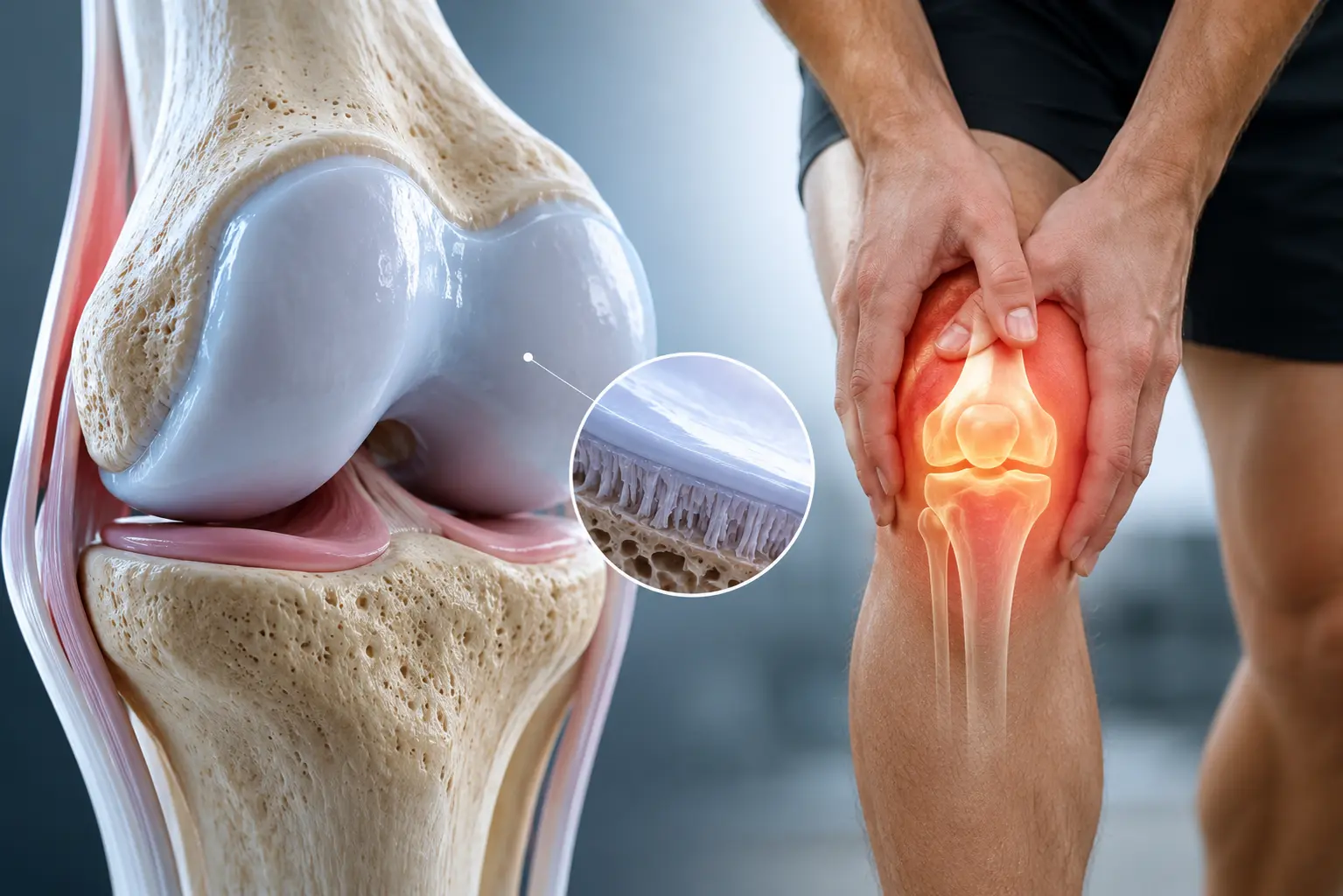
Articular cartilage is the thin, smooth, white tissue that caps the ends of the bones wherever two of them meet inside a joint. In the knee it lines the lower end of the thigh bone, the top of the shinbone, and the back of the kneecap, and its work is twofold: to offer a surface so slick that the joint glides with almost no friction and to spread out the compressive load that travels down through the knee with every step you take.
A review of cartilage lesions in the knee describes what it is built from, an extracellular matrix that is mostly water together with type II collagen and molecules called proteoglycans, a combination that lends the tissue both its springiness and its ability to take compression.
Just as importantly, cartilage is avascular and aneural, which is the medical way of saying it contains neither blood vessels nor nerves. That single fact explains a great deal, both why damaged cartilage stays quiet and painless in the early going and why it will not knit itself back together the way a cut in the skin so readily does.
This is really the question that shapes the whole of the treatment conversation that follows. Most tissue in the body repairs itself through a vascular response, with blood vessels ferrying the repair cells to wherever the injury sits, and since cartilage has no blood supply to speak of, that whole rescue simply never gets under way.
A review of the strategies used to repair articular cartilage confirms how poor its own intrinsic capacity for repair really is and notes that someone carrying cartilage damage is in the region of seven times more likely to go on to develop osteoarthritis than someone without it.
When the body does make an attempt at patching the gap, what it lays down is fibrocartilage, a scar-like tissue that fills the defect well enough but never acquires the orderly structure or the mechanical strength of the native hyaline cartilage it stands in for.
If knee pain is beginning to close in on your daily life and you would like to understand whether cartilage damage is part of what is going on, Dr. Rajesh Malhotra's clinic in Delhi can examine the joint and talk through what stage of care makes sense for you.
Can articular cartilage grow back?
Not in any reliable or natural fashion, no. The body may line a defect with fibrocartilage, but that filler is structurally poorer than the original hyaline cartilage and rather less durable with it. Surgical methods such as autologous chondrocyte implantation, where the patient's own cartilage cells are grown and reintroduced, do try to lay down something closer to the real thing, yet a complete regrowth of the original hyaline cartilage remains beyond us for now.
Is cartilage damage the same as arthritis?
Not quite. Cartilage damage can exist as a single focal lesion left by an injury, with no widespread arthritis anywhere about it. Osteoarthritis, by contrast, means a progressive and general loss of cartilage spread across the joint. The catch is that a focal patch of damage, left unattended, can be the very thing that precedes and feeds into arthritis later.
Does running or exercise damage cartilage?
Regular, moderate exercise tends on the whole to look after a joint rather than harm it, since the gentle cyclic loading actually helps keep the cartilage nourished and resilient. High-impact activity on a joint that already carries significant damage is a rather different matter, and that is one worth talking through with a specialist before you push on.
Copyright @2026 Design By DigitalNetIndia


