
Menu

- Monday - Saturday 09:00 AM- 8:30 PM
- Sunday - CLOSED

- +91 9319211545
- info@drrajeshmalhotra.com

- A -71, Second Floor, Rajouri Garden
- Metro Station, Delhi - 110027, INDIA
 93192 11545
93192 11545
93192 11545


Reviewed by Dr. Rajesh Malhotra | MS (Ortho) | Professor & Head of Orthopaedics, AIIMS | Orthopedic Surgeon, Rajouri Garden, Delhi
When I tell a patient that their hip replacement needs revising, which is to say that the original implant has to be reopened and either partly or wholly replaced or rebuilt, the first thing they ask is almost always why it has come to this.
The question they tend not to ask, and the one that matters just as much, is why the second operation should turn out so much harder than the first one was. It is worth answering properly, because the difficulty is real, and it is the reason revision hip arthroplasty sits among the most demanding procedures in all of orthopaedic surgery, the reason it takes so much longer on the table, and the reason the surgeon and the hospital you choose weigh far more heavily than they ever did for the original replacement.
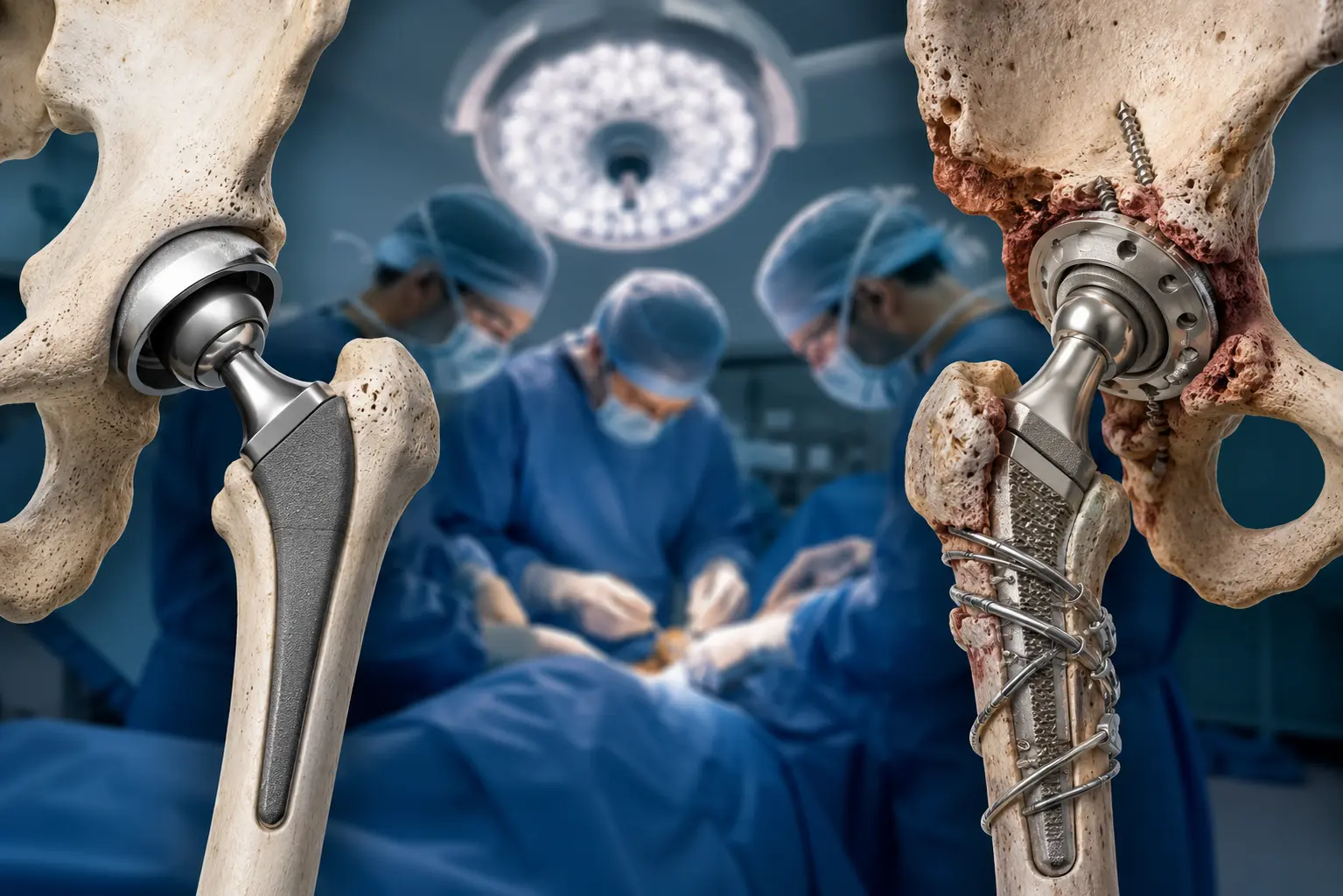
A first hip replacement begins on friendly ground. The anatomy is intact, the bone is natural, there is no old implant to work around and no scar tissue from a previous operation to cut back through. Revision begins from the opposite of all of that.
There is a prosthesis already sitting in the joint that has to come out, there is bone that has quietly reshaped itself around that prosthesis over the years, and there is a biological environment that has been altered by the slow shedding of wear particles, by inflammation, and in some cases by infection.
A published review of revision total hip arthroplasty puts it plainly, describing the procedure as technically demanding precisely because so much of the patient's own bone stock has usually been lost by then, a problem that the act of removing the original implant can quietly make worse rather than better.
Bone does not simply sit there quietly while an implant fails above it. As a worn prosthesis sheds its tiny particles, the body mounts an inflammatory response to them, and that response gradually dissolves the bone immediately around the implant in a process we call osteolysis.
A review of acetabular bone loss in revision hip replacement lists that same osteolysis alongside infection, instability, and mechanical failure of the implant as the usual reasons a hip comes to need revising in the first place, and every one of those routes tends to arrive at the same destination, which is a hip left short of the very bone a new implant needs to anchor itself into.
On the socket side of the joint, the part we call the acetabulum, the damage runs along a spectrum. At the milder end sits a contained cavity, a hollow with its surrounding walls still standing, whereas at the severe end the bony support for the cup has broken up altogether into what the literature terms pelvic discontinuity, where the socket has effectively parted into two separate pieces.
For patients across Delhi and the wider NCR who are facing a revision or who are simply uneasy about how a hip they had replaced years ago is holding up, Dr. Rajesh Malhotra's clinic offers a proper assessment at drrajeshmalhotra.com or on +91 93192 11545.
How long does revision hip surgery take compared to a primary replacement?
A good deal longer, as a rule. A first hip replacement is usually finished inside one to two hours, whereas a revision, depending on how much bone has already gone and how much rebuilding it calls for, can run anywhere from three to five hours and occasionally beyond that. The additional time spent under anaesthetic is itself part of why the overall risk of the operation sits higher.
How will I know if my hip replacement is failing?
The commonest warning by far is pain creeping back into or around the hip, and it is especially worth heeding when it turns up after a long stretch during which the joint had felt perfectly settled. Beyond that you might notice the leg beginning to feel or move differently, some swelling you can see, or a growing sense that the joint has become unsteady underneath you. None of these on its own means a revision is certainly coming, but every one of them is a fair reason to have the hip looked at rather than waiting it out.
Copyright @2026 Design By DigitalNetIndia


