
Menu

- Monday - Saturday 09:00 AM- 8:30 PM
- Sunday - CLOSED

- +91 9319211545
- info@drrajeshmalhotra.com

- A -71, Second Floor, Rajouri Garden
- Metro Station, Delhi - 110027, INDIA
 93192 11545
93192 11545
93192 11545


Reviewed by Dr. Rajesh Malhotra | MS (Ortho) | Professor & Head of Orthopaedics, AIIMS | Orthopedic Surgeon, Rajouri Garden, Delhi
Many people swallow their calcium and vitamin D3 tablets religiously, year after year, and still come away from a bone density scan to find their doctor frowning at the result. The supplements are not counterfeit, and the deficiency they were prescribed for is perfectly real, so the puzzle has to sit somewhere else entirely, in how these particular nutrients actually go about their work and why a tablet on its own so seldom finishes the job.
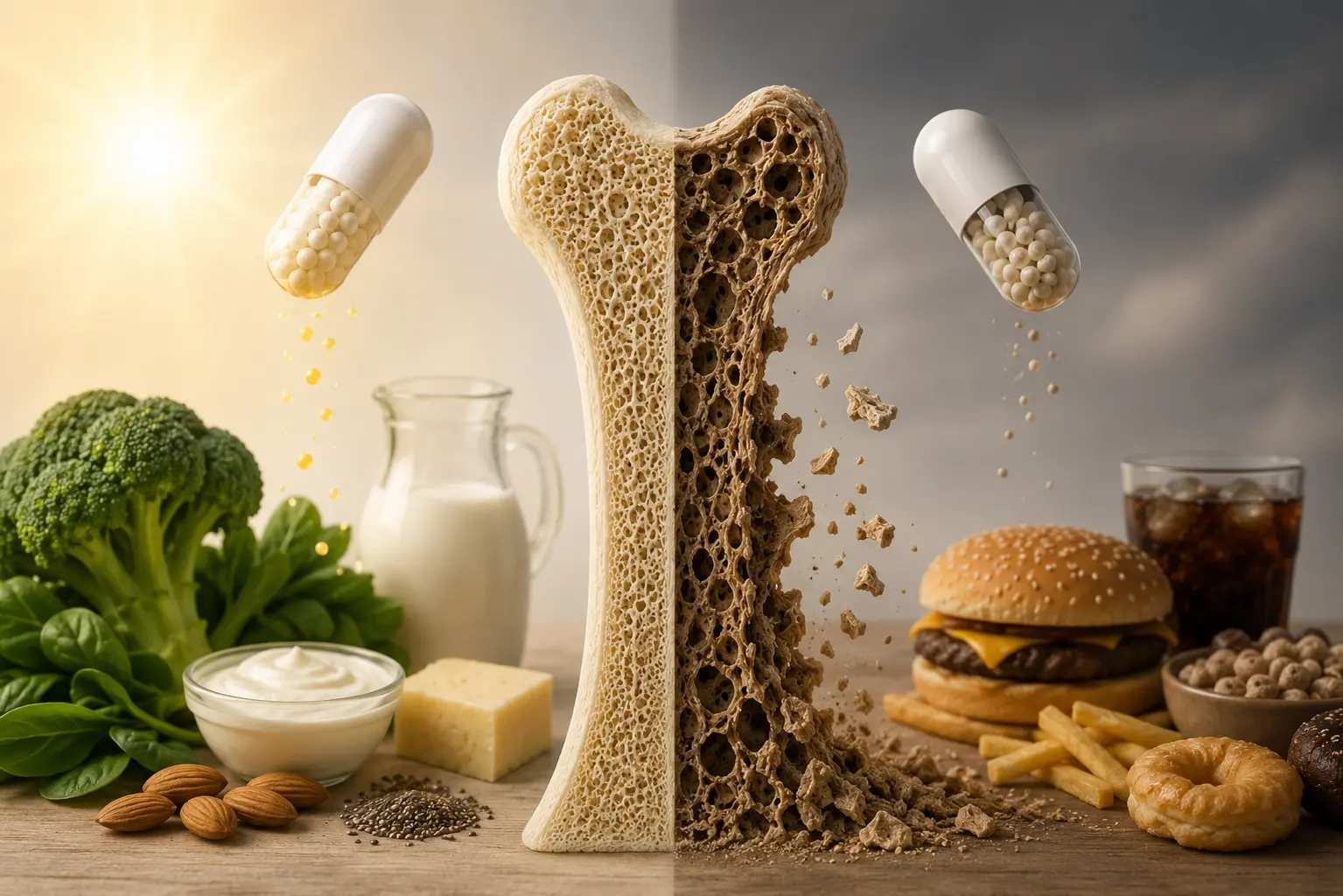
The picture that keeps emerging from the research is that calcium and D3 were never really meant to act alone. They are one part of a larger system, and most of the rest of that system arrives not in a capsule but on your plate.
The vitamin D3 sitting in a capsule is not yet the same substance as the active vitamin D working away inside you.
What you swallow has to be converted twice over before it can do anything useful, first by the liver and then by the kidneys, until it finally becomes the hormonal form that governs how much calcium your gut is able to take up.
Each of those conversion steps is driven by an enzyme, and those enzymes simply cannot function without magnesium. A review of vitamin D as, in effect, a team player is blunt about the point, noting that magnesium is the cofactor for the kidney enzyme, 1α-hydroxylase, that turns inactive vitamin D into its active form.
If you starve your body of dietary magnesium, the D3 you have carefully taken remains in its dormant state, drifting through the bloodstream without ever doing what it was prescribed to do.
Vitamin D3 is very good at one specific task, which is coaxing more calcium out of your food and into your bloodstream, and yet it has no say whatsoever over where that calcium then chooses to go.
This is where vitamin K2 quietly earns its keep, because in its absence the calcium you have gone to such trouble to absorb can settle just as readily into soft tissue and the walls of your arteries as into the skeleton you were hoping to strengthen.
A review of the supplements that genuinely help bone health lays the mechanism out clearly enough: vitamin K switches on a set of proteins, osteocalcin among them, whose job is to bind calcium into the actual fabric of bone, and until those proteins have been switched on, they sit idle no matter how much calcium happens to be floating past them.
It matters far more than almost anyone expects it to. Vitamin D3 is fat-soluble, which is really just a technical way of saying that it needs a little dietary fat alongside it to cross out of the gut and into the blood at all, so swallowing it on an empty stomach or washing it down with a fat-free meal quietly throws a good deal of the dose away.
Pair it instead with some modest thing that carries a bit of healthy fat, a couple of eggs, a handful of nuts, a little full-fat dairy, even a thread of olive oil over your food, and the amount that genuinely reaches your system climbs considerably.
Where bone health is genuinely on your mind, whether because of osteoporosis, a fracture that has not long healed, or surgery on a joint, Dr. Rajesh Malhotra's clinic in Delhi can advise on the nutritional and medical support that actually fits your own situation.
Should I take calcium and D3 at the same time?
Yes, the two work well in tandem, though both do rather better taken with a meal that carries a little fat. Try not to swallow your calcium alongside foods heavy in oxalates or phytates, since those have a way of blunting how much of it you manage to absorb.
What is vitamin K2, and is it the same as K1?
They are not the same thing at all. Vitamin K1, the sort you get from leafy greens, is chiefly concerned with helping your blood to clot. Vitamin K2, which comes instead from fermented foods and a handful of animal products, is the one that activates the proteins steering calcium into bone. The same letter, and genuinely different jobs.
Copyright @2026 Design By DigitalNetIndia


